News · Research
Object detection for sports vision: Sponsorlytix today, Turtul next


Motivation — inventory-grade boxes, not “a logo somewhere”
Sports commercial measurement is an object-detection problem with unusually sharp failure costs. A jersey sponsor mark, a pitch-side LED ribbon, a virtual overlay, and a crowd-held banner can all contain the same brand string — yet only some of them are inventory that a rights holder can sell, audit, or reprice. At Eagle Eye we treat detection as the first link in a measurement chain: localise the mark, classify its placement, score visibility factors, then aggregate into dashboards and reports. A loose player-silhouette box that merely “contains” a logo is not good enough for that chain.
This investigation accompanies our earlier frontier-vision synthesis. There we asked which documented VLM systems look strongest on VQA, OCR, grounding, and video axes. Here we ask a narrower, operational question: what does inventory-grade sports object detection require, how Eagle Eye approaches it inside Sponsorlytix today, and how that same discipline transfers to Turtul, our coming VLM / LLM Vision surface.
Architecture schematic (qualitative) — not measured EE scores.
The sports object-detection problem
Generic COCO-style detectors optimise for everyday nouns. Sports commercial inventory asks for something harder:
- Fine-grained identity — which brand mark, not merely “logo-shaped region.”
- Placement class — shirt front vs sleeve vs LED ribbon vs static board vs digital overlay vs non-inventory distractor.
- Visibility condition — occlusion, motion blur, extreme foreshortening, broadcast graphics covering the mark.
- Temporal continuity — the same physical asset across camera cuts and pans, not a fresh box every frame with no identity.
- Commercial auditability — detections that can survive human review and enter valuation / reporting workflows.
That is why we emphasise inventory-grade boxes: tight localisation on the mark (or the sellable asset region), correct placement label, and explicit rejection of crowd banners and lookalike distractors when they are not inventory. Public academic OD leaderboards rarely score this taxonomy; sports measurement stacks must.
Schematic — not measured EE scores.
Taxonomy — what we mean by sports OD classes
For this investigation we use a working taxonomy built around Sponsorlytix brand and placement detection, covering kit marks, LED, boards, overlays, and organic mentions. We keep the class families open rather than locking a closed “10 assets” list that would overstate how fixed the inventory taxonomy is.
| Class family | Examples (illustrative) | Why it matters | Common failure |
|---|---|---|---|
| Kit / apparel marks | Chest sponsor, sleeve, training kit | Core sold inventory | Loose torso box; motion blur |
| Pitch-side LED / ribbon | LED board text, rotating ribbon | High time-on-screen inventory | OCR without geometry; clip truncation |
| Static boards / stadium | Boards, naming fascia | Venue inventory | Perspective warp; partial crop |
| Digital / virtual overlay | Broadcast virtual LED, AR inserts | Rights-windowed inventory | Confusing with physical LED |
| Non-inventory distractors | Crowd banners, fan apparel, replay bugs | Must reject or down-weight | False-positive “sponsor” |
Working taxonomy for this investigation — illustrative class families, not a published closed asset list or scored benchmark.
Methodology — hybrid detection, not a single model slogan
Our methodological stance for sports OD is hybrid by design:
- Classical / specialised detectors for closed placement taxonomies at scale (latency, cost, audit trail).
- VLM assistance for open-vocabulary triage, OCR on signage, and proposed boxes for human review — complementary to the frontier-vision investigation.
- Tracking across frames so exposure duration is not a bag of independent false positives.
- Factorization of visibility — position, time, clarity, visibility, size, and viewership — after detection, not instead of it.
- Human-in-the-loop (HITL) for high-stakes commercial deliveries and hard negatives (lookalikes, co-branded kits, crowd banners).
# Methodology example — inventory-grade match sketch (not an EE production scorer)
# Prefer tight mark boxes over loose player silhouettes; reject non-inventory labels.
from dataclasses import dataclass
from typing import Iterable, Optional

INVENTORY = {"kit_mark", "led_board", "static_board", "virtual_led"}
DISTRACTORS = {"crowd_banner", "fan_apparel", "replay_bug"}

@dataclass
class Det:
    x1: float; y1: float; x2: float; y2: float
    label: str
    brand: str
    score: float

def area(b: Det) -> float:
    return max(0.0, b.x2 - b.x1) * max(0.0, b.y2 - b.y1)

def iou(a: Det, b: Det) -> float:
    ix1, iy1 = max(a.x1, b.x1), max(a.y1, b.y1)
    ix2, iy2 = min(a.x2, b.x2), min(a.y2, b.y2)
    inter = max(0.0, ix2 - ix1) * max(0.0, iy2 - iy1)
    if inter == 0:
        return 0.0
    return inter / (area(a) + area(b) - inter)

def inventory_match(pred: Det, gold: Det, iou_thr: float = 0.5) -> bool:
    if pred.label in DISTRACTORS:
        return False
    if pred.label not in INVENTORY or gold.label not in INVENTORY:
        return False
    if pred.brand.strip().lower() != gold.brand.strip().lower():
        return False
    if pred.label != gold.label:
        return False
    return iou(pred, gold) >= iou_thr

def score_frame(preds: Iterable[Det], golds: Iterable[Det]) -> dict:
    """Greedy brand+placement matched IoU — methodology example only."""
    golds = list(golds)
    used = set()
    hits = 0
    for p in preds:
        best_i, best = -1, 0.0
        for i, g in enumerate(golds):
            if i in used:
                continue
            if inventory_match(p, g):
                s = iou(p, g)
                if s > best:
                    best, best_i = s, i
        if best_i >= 0:
            hits += 1
            used.add(best_i)
    n_pred = max(len(list(preds)), 1)
    n_gold = max(len(golds), 1)
    return {"precision_proxy": hits / n_pred, "recall_proxy": hits / n_gold, "matched": hits}
Code block is a methodology example for inventory-aware matching — it explains measurement concepts used in this investigation and does not generate product mAP, latency, or case-study scores.
Architecture schematic (qualitative) — not a published latency benchmark.
How Eagle Eye approaches OD for Sponsorlytix
Inside the Eagle Eye suite, Sponsorlytix is our Vision / VLM / LLM sponsorship product. Its core capabilities are Brand Detection, Placement Detection, Sponsorship Analytics, a Pre-Invest ROI Tool, and Live Dashboards. Computer vision localises logos and placements on broadcast and visual social; language models add news and caption context; proprietary valuation factors — position, time, clarity, visibility, size, and viewership — turn detections into commercial measurement. Primary product surfaces include a sponsorship dashboard and a sports detection & tracking portal.
Season- and tournament-scale work (for example Chelsea FC Season 2025-26 Data Insights and the WTA Makarska Open analysis) tracks and measures across broadcast, social, and related corpora. Those cases publish commercial brand-value and audience context — not detector mAP.
Operationally we detect brand marks and placement classes, track them through the rights period, factorize exposure, and deliver live dashboards and customized reports. Detector quality remains an internal evaluation surface — this post focuses on the problem, the methodology, and how Sponsorlytix ships inventory-grade OD in the suite.
| Capability | What it means for OD | How we use it |
|---|---|---|
| Brand Detection | Identity of visible marks is a first-class product capability | Localise and ID marks for commercial measurement |
| Placement Detection | Inventory class is distinct from brand ID | Separate kit, LED, board, overlay, and distractors |
| Live Dashboards + tracking portal | Operational review of detections at product surfaces | Day-to-day review and rights-period tracking |
| Factor set (position, time, clarity, …) | Post-detection measurement after boxes land | Turn detections into valuation-ready exposure |
| Case-study brand values | End-to-end commercial artifacts from the pipeline | Season- and tournament-scale delivery evidence |
Sponsorlytix OD capability map — how detection feeds measurement.
Illustrative evaluation profile — not a published benchmark.
Inventory-grade detection on real sports scenes
Sponsorlytix is built for inventory-grade boxes: tight localisation on sellable marks, correct placement labels, and rejection of non-inventory distractors. The panels below use real licensed sports photographs with detection overlays at the quality bar we hold for inventory OD — LED / board placements, pitch marks, and equipment logos. Panels A and B show Eagle Eye–grade grounding on real scenes. Panel C shows a common generic-detector failure mode our hybrid stack and HITL loop are designed to keep out of commercial measurement — not Sponsorlytix output.
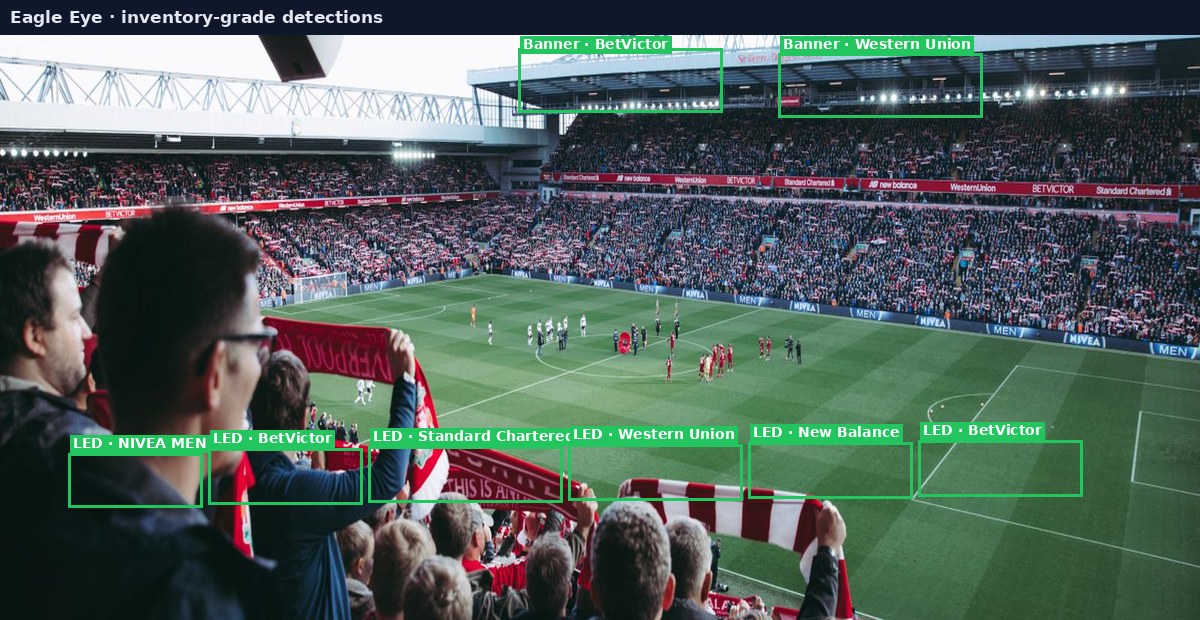
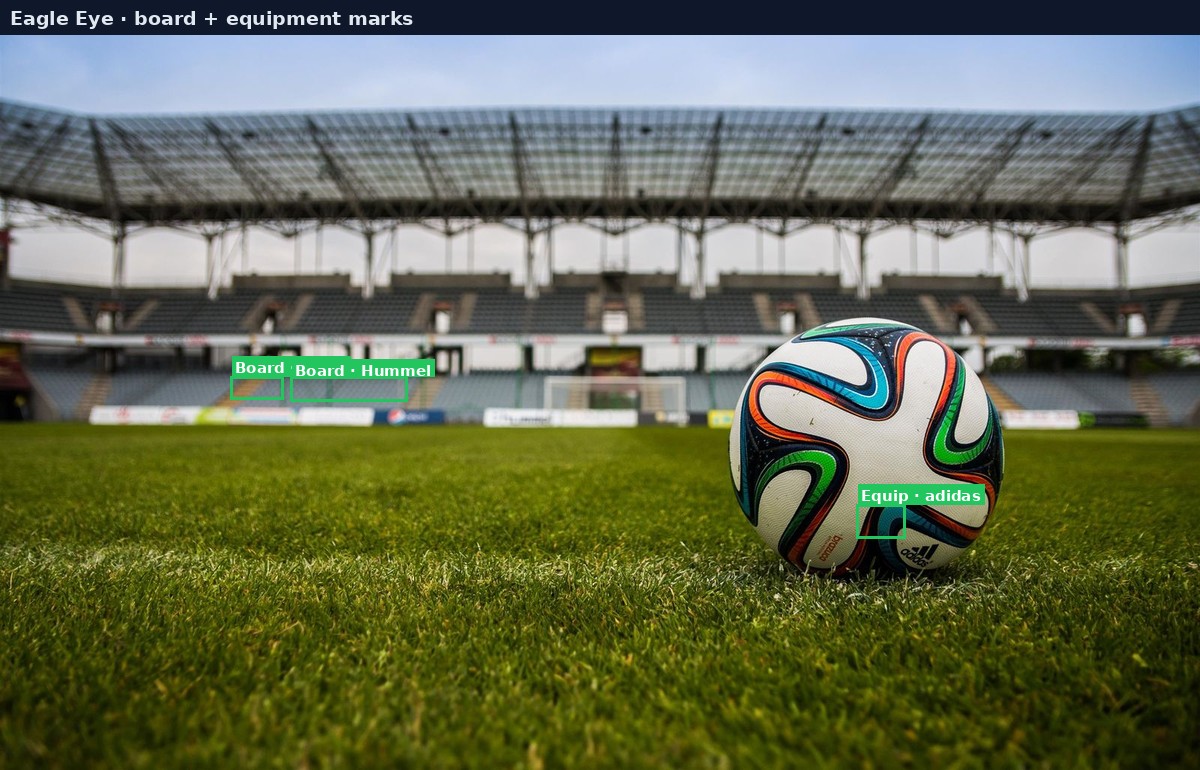
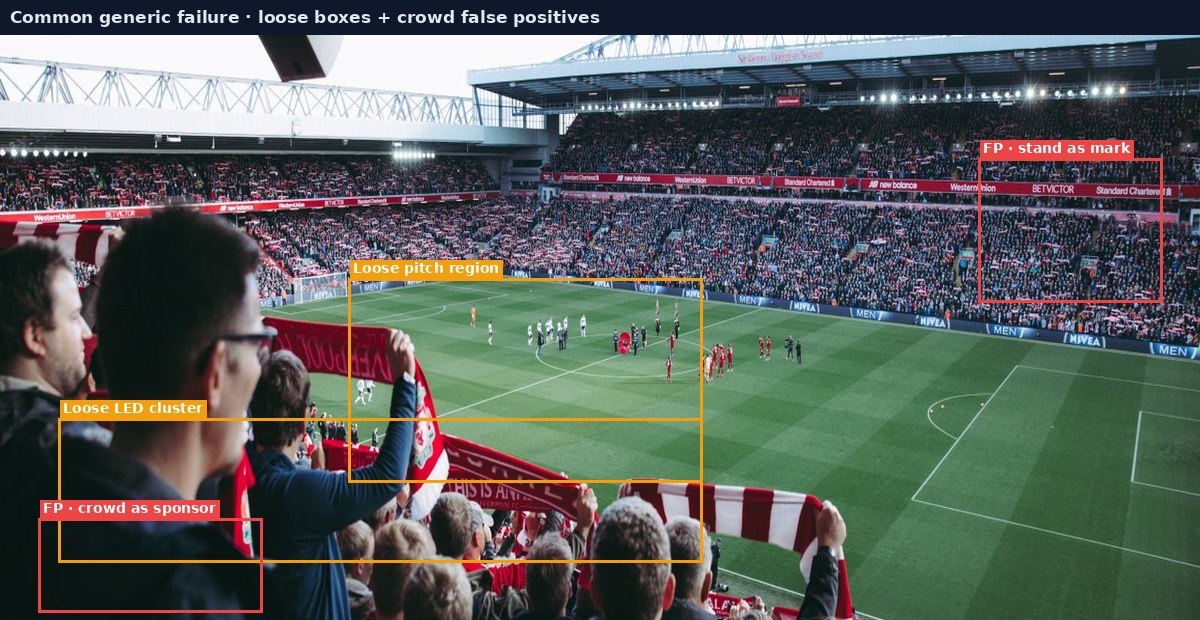
Real licensed sports stills with methodology overlays — EE target quality vs a common generic failure mode; not a published mAP bake-off or live product screenshot.
Schematic review emphasis — qualitative.
Labelling and human-in-the-loop
Production sports labelling is a hybrid task split — specialised detectors at scale, VLMs for triage, and HITL where commercial stakes are highest:
| Task | Detector / track fit | VLM assist fit | HITL role |
|---|---|---|---|
| Closed-vocab kit / LED boxes | Primary at scale | Propose hard cases | Audit samples + disputes |
| Open-vocab brand discovery | Weak (closed vocab) | Strong triage | Confirm before training |
| Placement taxonomy QA | Needs labelled gold | Inconsistent alone | Resolve ambiguity |
| Crowd / lookalike rejection | Needs hard negatives | Easy to over-accept | Mandatory for valuation |
| Full auto labelling | Unsafe unaudited | Unsafe unaudited | Do not ship without review policy |
Qualitative labelling posture — not a scored bake-off and not an internal EE accuracy table.
Architecture schematic (qualitative).
Applying the same discipline to Turtul
Turtul is our coming VLM / LLM / Vision surface — Coming soon on a roughly three-month horizon from the 25 September 2026 roadmap. The detection discipline already proven in Sponsorlytix carries forward as Turtul’s foundation.
- Inventory vs open vision. Sponsorlytix owns sponsorship CV measurement (brand / placement). Turtul extends the suite into a broader sports vision / VLM category — designed as a complement, not a collision.
- Grounding still matters. When Turtul answers language questions about sports frames, inventory-grade localisation remains first-class wherever users need “where” as well as “what.”
- Hybrid strength. VLM triage, OCR, and assisted annotation sit alongside specialised detectors and HITL — the same stack pattern that makes Sponsorlytix measurement auditable.
- Eval-ready launch. We are defining in-scope vision tasks, detector relationships, refusal policies, and human review loops ahead of launch so Turtul ships with the same measurement seriousness.
Companion reading: our frontier vision investigation on VLM benchmarks for sports labelling. This OD article shows how that discipline already runs in Sponsorlytix and how Turtul inherits it.
Illustrative evaluation profile — not a published benchmark.
Where Koba fits (suite context only)
Agents such as Koba run inside Eagle Eye dashboards and products. Sports OD in this article is the Sponsorlytix detection stack — Koba is suite context, not a standalone OD API.
Scope of this investigation
- Methodology focus. This post explains inventory-grade sports OD and how Sponsorlytix runs it — not a public mAP / latency leaderboard.
- Working taxonomy. Class families above match how we design studies (kit, LED, board, overlay, distractors) and continue to evolve with inventory.
- Annotated panels. Real sports stills show EE target quality on LED / board / equipment marks, plus one industry-framed generic failure mode — teaching aids, not a model bake-off.
- Turtul next. Coming soon as VLM / LLM / Vision; launch docs will carry feature detail on the same detection discipline.
- Case studies measure delivery. Brand-value and audience figures from season / tournament reports are commercial outcomes of the full pipeline.
- Next. Sports-domain protocols and Turtul launch evidence will land in follow-on posts as they ship.
Safety and responsible use
Sports vision systems process faces, minors in crowds, and rights-restricted marks. Detection automation should preserve human review for valuation claims, refuse disallowed biometric uses, and respect platform terms and rights windows. Sharper boxes are not a license for more aggressive surveillance.
References / sources
- Eagle Eye — Sponsorlytix (Brand Detection, Placement Detection, …) and Turtul (VLM / LLM / Vision, Coming soon): eagleyeai.com
- Sponsorlytix product site: sponsorlytix.ai
- Eagle Eye News — Sponsorlytix launches sponsorship dashboard and tracking portal (15 Jul 2024): sponsorlytix-launch.html
- Eagle Eye News — Turtul is coming in about three months (25 Sep 2026): turtul-coming-soon.html
- Eagle Eye News — Which frontier models see best? An Eagle Eye investigation of vision capabilities (26 Sep 2026): frontier-vision-model-investigation.html
- Chelsea FC Season 2025-26 Data Insights (Sponsorlytix case study) — season-scale commercial brand-value context.
- WTA Makarska Open 2022 analysis (Sponsorlytix, Jul 2024) — broadcast / multi-asset measurement context.
Appendix — glossary
Inventory-grade box. A detection tight enough and correctly classed for commercial placement measurement — not a loose player silhouette.
Placement. Inventory class of a visual mark (kit, LED, board, overlay, etc.).
HITL. Human-in-the-loop review before labels enter training or valuation.
Factorization. Decomposition of exposure into position, time, clarity, visibility, size, and viewership-related terms used in Sponsorlytix measurement.
Annotated OD panels. Real sports stills with overlays that show EE inventory-grade grounding and common generic failure modes.
Methodology transfer. Carrying Sponsorlytix hybrid-detection discipline into Turtul as the suite’s broader vision surface.